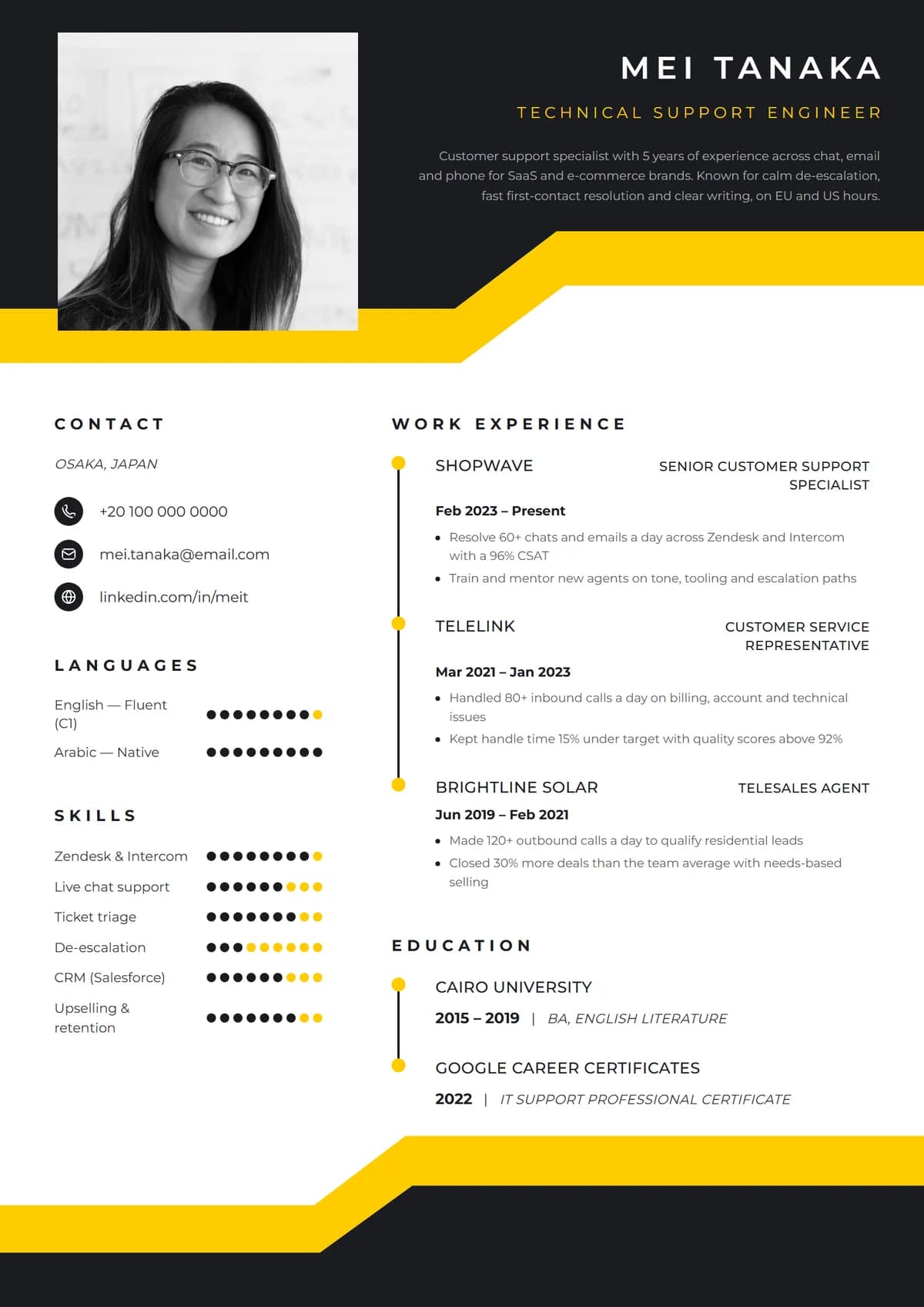
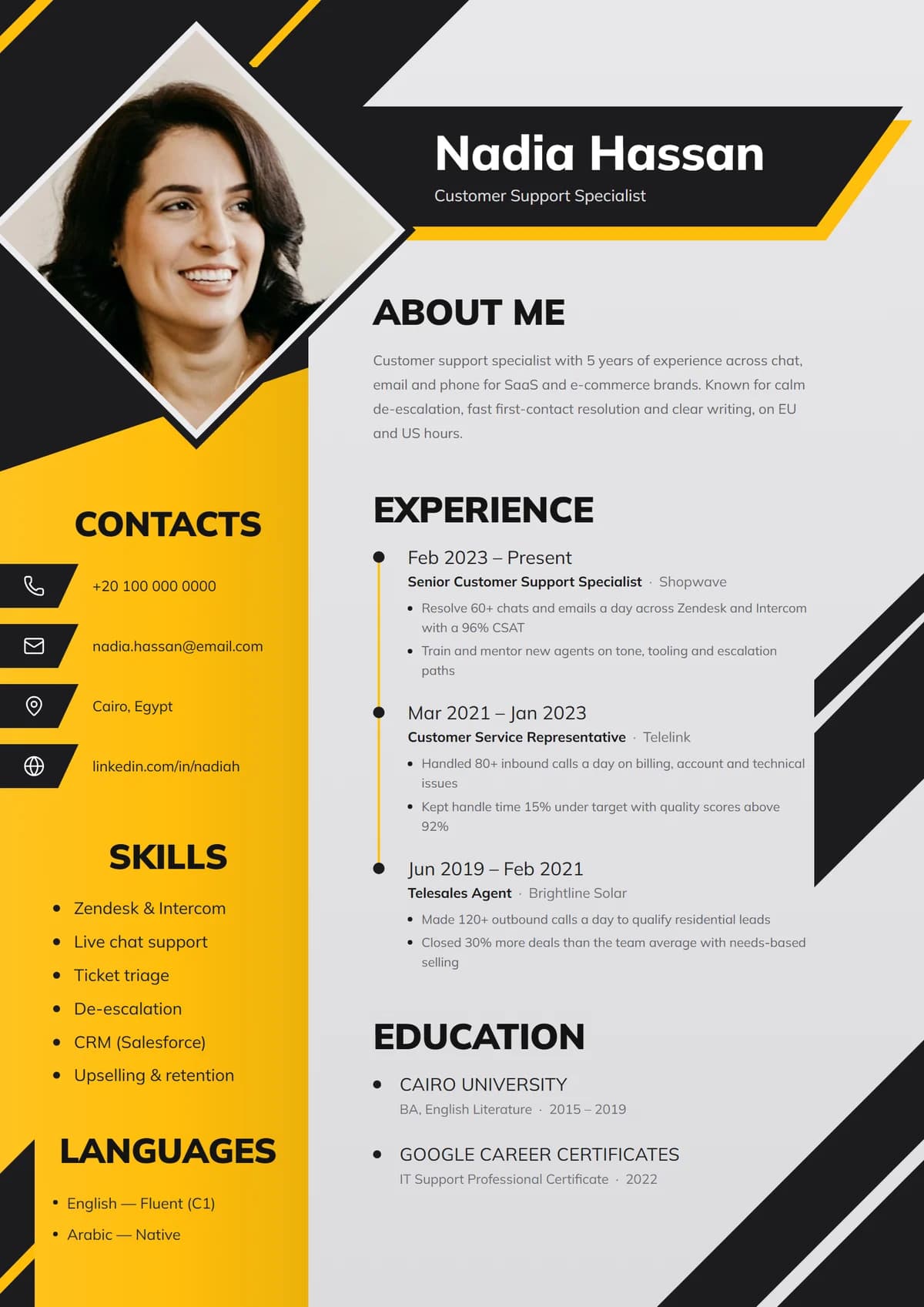
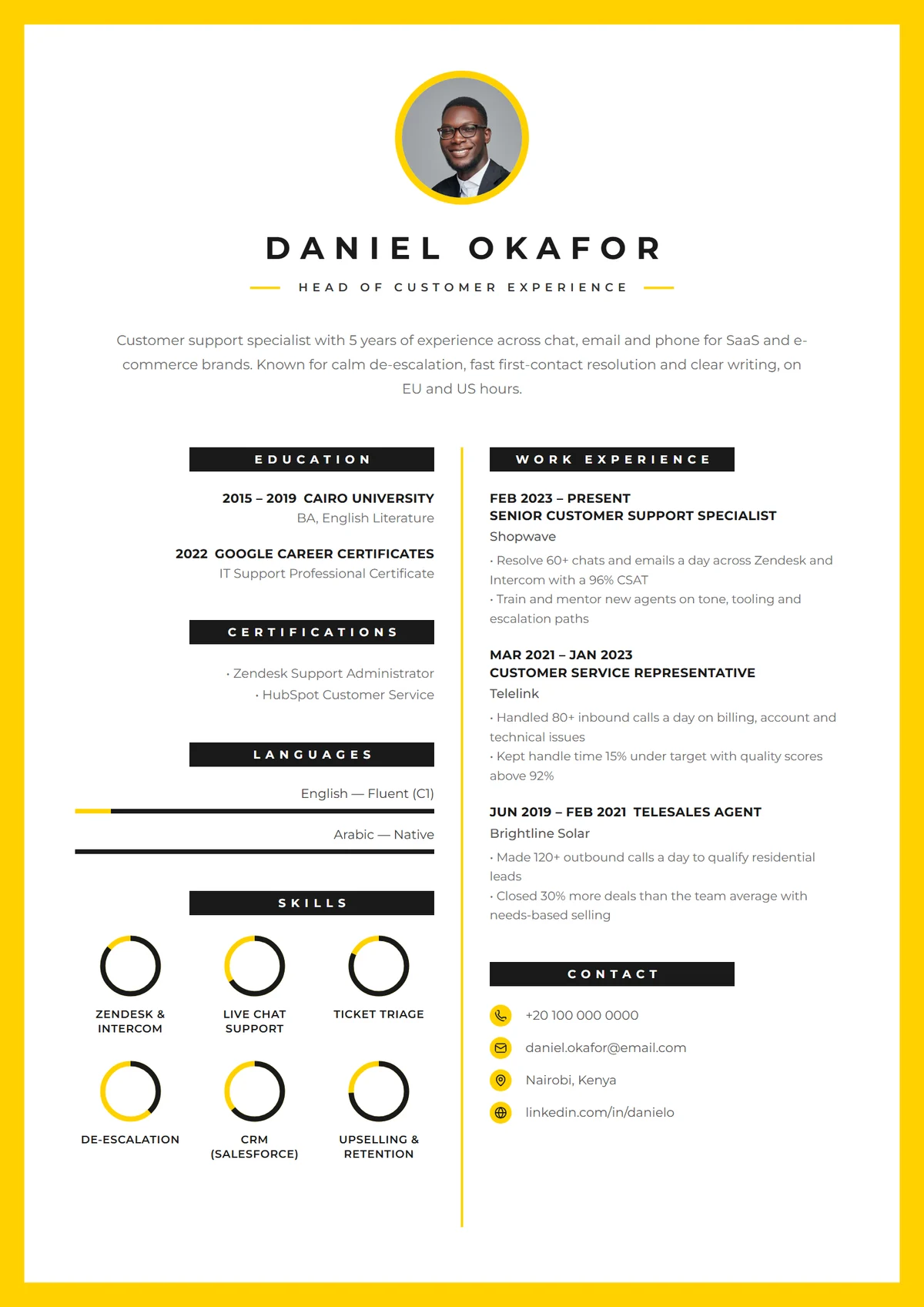
"Resume" and "CV" are sometimes two different documents and sometimes two names for the same one. It depends on where the employer is. If you're applying to remote jobs across borders, knowing the difference saves you from sending a ten-page academic history to a recruiter who wanted one page, or the other way round.
The short answer
- Resume: a short, tailored summary of your experience and skills, usually one or two pages. The standard in the US and Canada.
- CV (curriculum vitae): literally "the course of life". In the US it means a long, complete academic record. In the UK, Ireland, much of Europe, Africa, the Middle East and Asia, "CV" is simply the everyday word for a resume.
So a UK recruiter asking for your CV and a US recruiter asking for your resume usually want the same thing: a focused one- or two-page document.
Side by side
| Resume | Academic CV (US sense) | |
|---|---|---|
| Length | 1 – 2 pages | As long as needed, often 3 – 10+ |
| Purpose | Win an interview for a specific job | Show your complete academic record |
| Tailored? | Yes, for each role | Mostly the same each time |
| Content | Summary, experience, skills, education | Education, research, publications, teaching, grants, conferences |
| Used for | Almost all jobs | Academia, research, medicine, some scientific roles |
What each word means where you're applying
- United States and Canada: "resume" for jobs; "CV" only for academic, medical and research roles.
- United Kingdom and Ireland: "CV" means a two-page resume. "Resume" is understood but rarely used.
- Australia and New Zealand: both words are used, usually for the same short document.
- Germany, Austria and Switzerland: a "Lebenslauf" (CV), often with a photo, sent alongside a cover letter and certificates.
- France, Spain, Italy and much of Europe: "CV", usually one or two pages. The Europass CV format exists, but many recruiters prefer a cleaner design.
- Gulf states and the wider Middle East: "CV", often with a photo and sometimes nationality and visa status.
- India, Pakistan and Bangladesh: "CV", "resume" and "biodata" are all used. Biodata traditionally includes personal details that most international employers don't want.
- Africa: "CV" is the common word, following UK conventions in most countries.
- Japan: a formal "rirekisho" form for many local employers, but international companies accept an English resume.
Working remotely for a foreign company? Follow the conventions of the employer's country, not yours. A US company wants a US-style resume, even if you live in Egypt, Kenya or the Philippines.
Personal details: what to include and what to leave out
Conventions vary, but for international and remote applications a safe rule is:
- Include: name, job title, email, phone with country code, city and country, LinkedIn or portfolio.
- Include if relevant: time zone and the hours you can work; work authorisation if the posting asks.
- Leave out unless asked: date of birth, age, marital status, religion, ID or passport numbers, full street address.
Should you put a photo on your resume?
| Region | Photo? |
|---|---|
| US, Canada, UK, Ireland, Australia, New Zealand | No. Many employers remove resumes with photos to avoid bias claims. |
| Germany, Austria, Switzerland | Common and often expected, though no longer required. |
| France, Spain, Italy, Belgium | Common, optional. |
| Middle East and North Africa | Common and often expected. |
| Much of Asia | Common for local employers. |
| Remote roles with international companies | Usually leave it off unless the posting asks. |
If you include one, use a recent, well-lit, professional headshot against a plain background. Our guide to choosing a resume template shows how to pick a design that works with or without a photo.
When you actually need an academic CV
You need a full CV in the US sense if you're applying for:
- University teaching or research positions
- PhD programmes, fellowships and grants
- Medical and clinical roles in some countries
- Some scientific and policy research jobs
A typical academic CV includes: education, research interests, publications, presentations, teaching experience, grants and awards, professional memberships and references.
How to tell which one an employer wants
- 1.Read the posting. If it asks for a "CV" but the role isn't academic, send your one- or two-page resume.
- 2.Look at the employer's location. Follow that country's conventions.
- 3.Check the length limit in the application form, if there is one.
- 4.When in doubt, send a two-page maximum. A focused document is never the wrong choice outside academia.
One document, two names
For most people the practical answer is simple: keep one strong, one-page resume and call it a CV or a resume depending on who's asking. Tailor it for each role, and keep a version with a photo for employers in regions where photos are expected.
Remote's resume builder lets you keep several versions side by side, such as one with a photo and one without, and download either as a PDF. Sign up free to build yours, and read how to write a CV for remote customer service jobs for role-specific advice.