Some careers pay three or four times what others do, and it is rarely luck. Pay follows a few clear patterns: how rare the skill is, how much money rides on your decisions, and how close you sit to the revenue. This guide explains those patterns using the latest official wage data, mostly from the US Bureau of Labor Statistics (BLS), which publishes the most detailed pay figures of any country. Every number links to its source.
The short version: management, computing, law and engineering are the best-paid career families. Doctors are the best-paid single jobs almost everywhere. A bachelor's degree still lifts typical pay by more than 60% over a high school diploma, but many well-paid careers in tech, sales and project management are open without a doctorate. Nurse practitioners, data scientists and security analysts are both well paid and growing fast.
Want the numbers for other countries? See the highest-paying careers on every continent.
Job or career: what's the difference?
A job is the role you hold today. A career is the path those roles add up to: the skills you build, the responsibility you take on and the pay that follows. A customer service agent who becomes a team lead and then a customer success manager has one career across three jobs.
Careers group into families that share skills: healthcare, computing, finance, engineering, sales, management and so on. Pay is set much more by the family and the level you reach in it than by the job title you start with. That is why the charts below look at both.
Five things that decide what a career pays
- 1.Scarcity. If a skill takes years to learn or few people can do it, employers compete for it. This is why surgeons, anesthesiologists and pilots top every list.
- 2.Responsibility and risk. The more money, safety or people that depend on your decisions, the more you are paid. Managers earn about 2.5 times the typical US worker.
- 3.Closeness to revenue. Roles that bring money in, like sales, finance and trading, tend to pay well, often with bonuses or commission on top.
- 4.Leverage. Work that can be copied at no cost pays well. Code written once can serve millions of users, so software developers earn far more than the average.
- 5.Where the employer is. The same skill is paid very differently in different countries. A remote job paid from a high-wage market can change what a career is worth to you. We compare countries in the continent-by-continent guide.
Which career families pay the most
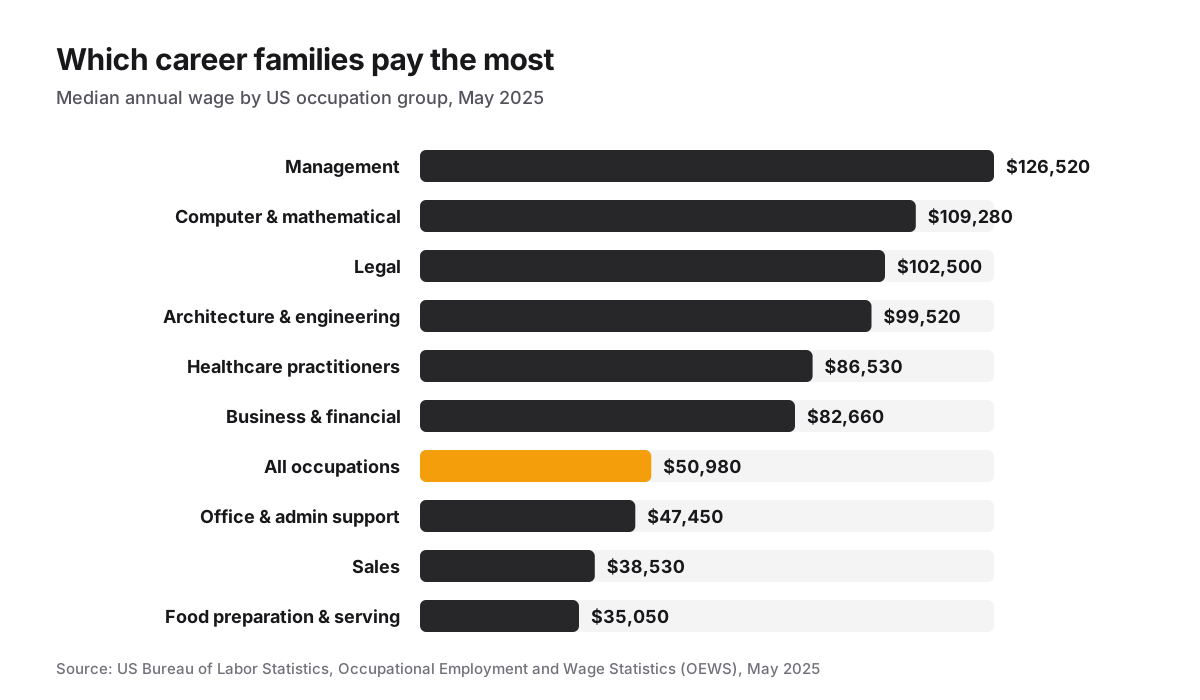
The BLS sorts every US job into 22 occupation groups. Here are the best-paid groups, a few of the lowest, and the figure for all jobs combined.
| Occupation group | Median annual wage | vs all jobs |
|---|---|---|
| Management | $126,520 | 2.5× |
| Computer & mathematical | $109,280 | 2.1× |
| Legal | $102,500 | 2.0× |
| Architecture & engineering | $99,520 | 2.0× |
| Healthcare practitioners & technical | $86,530 | 1.7× |
| Business & financial operations | $82,660 | 1.6× |
| All occupations | $50,980 | 1.0× |
| Office & administrative support | $47,450 | 0.9× |
| Sales & related | $38,530 | 0.8× |
| Food preparation & serving | $35,050 | 0.7× |
Source: BLS Occupational Employment and Wage Statistics, May 2025. The median is the middle wage: half of workers earn more and half earn less.
Two things stand out. First, the gap is large: a typical manager earns more than three times a typical food service worker. Second, the sales group sits low because it includes millions of retail cashiers and counter staff. Sales roles selling to businesses pay much more, as the career ladder further down shows.
The highest-paying single jobs
Inside the families, a handful of jobs pay far more than anything else. In the US, physicians and surgeons lead. The BLS lists pediatric surgeons with the highest average wage of any occupation at $502,050, followed by cardiologists at $454,940.
| Job | Median annual wage (US, 2025) |
|---|---|
| Anesthesiologists | $391,490 |
| Nurse anesthetists | $236,590 |
| Airline pilots, copilots & flight engineers | $232,140 |
| Chief executives | $213,990 |
| Computer & information systems managers | $175,140 |
| Dentists (general) | $170,950 |
| Financial managers | $166,570 |
| Lawyers | $159,670 |
| Software developers | $135,980 |
Source: BLS OEWS, May 2025.
Most of these need long training, a licence, or both. Medicine takes ten years or more after school. That training is part of why the pay is high, and it is also why these careers are hard to switch into later.
Does education still pay?
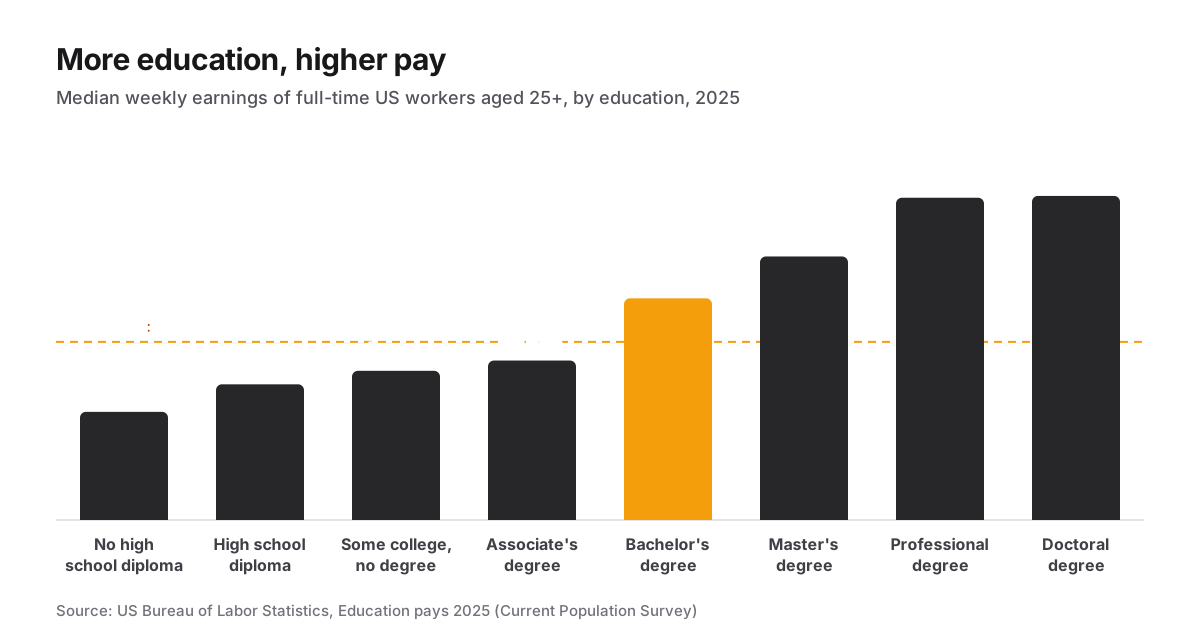
Yes, on average, by a wide margin. Full-time workers with a bachelor's degree earn a median of $1,578 a week, about 63% more than those with only a high school diploma. They are also less likely to be out of work.
| Education | Median weekly earnings | Unemployment rate |
|---|---|---|
| Doctoral degree | $2,307 | 1.8% |
| Professional degree | $2,294 | 1.9% |
| Master's degree | $1,876 | 2.6% |
| Bachelor's degree | $1,578 | 2.8% |
| Associate's degree | $1,135 | 3.0% |
| Some college, no degree | $1,062 | 3.8% |
| High school diploma | $966 | 4.3% |
| Less than high school | $770 | 6.1% |
| All workers | $1,268 | 3.4% |
Source: BLS, Education pays 2025. Full-time workers aged 25 and over; the 2025 figures average 11 months.
These are averages across everyone. What you study and the career you choose matter as much as the degree level. A bachelor's in computer science and a bachelor's in a field with few jobs lead to very different pay. And plenty of people in tech, sales and operations earn well on skills, certifications and a track record rather than a degree.
Well-paid careers that are growing fast
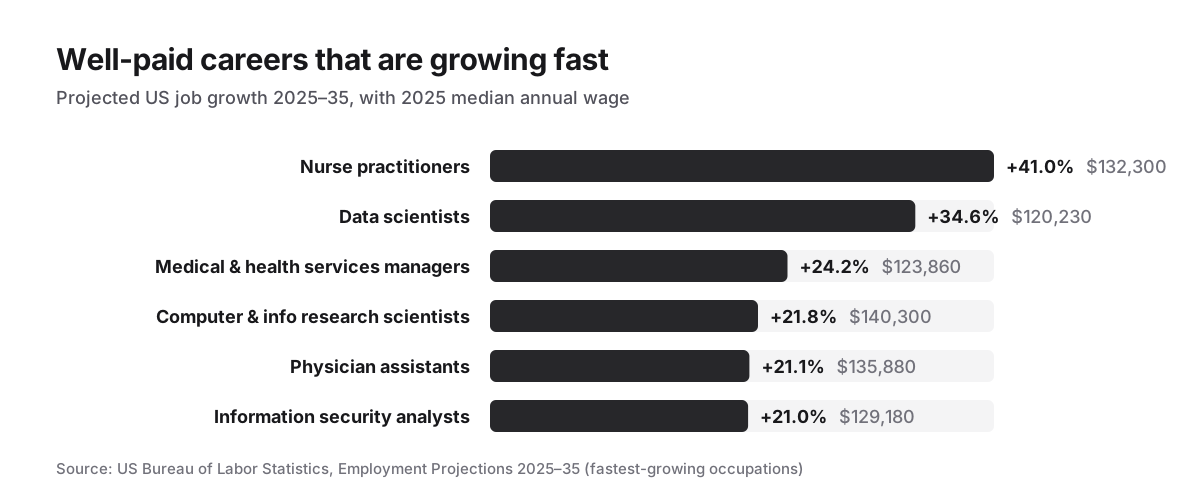
Pay today is only half the picture. A career that is growing gives you more openings, more room to move up and more bargaining power. The BLS projects which jobs will grow fastest over the next ten years. These six are both fast-growing and paid well above the median.
| Career | Projected growth, 2025–35 | Median wage, 2025 |
|---|---|---|
| Nurse practitioners | +41.0% | $132,300 |
| Data scientists | +34.6% | $120,230 |
| Medical & health services managers | +24.2% | $123,860 |
| Computer & information research scientists | +21.8% | $140,300 |
| Physician assistants | +21.1% | $135,880 |
| Information security analysts | +21.0% | $129,180 |
Source: BLS Employment Projections, fastest-growing occupations 2025–35.
The pattern is clear: healthcare, driven by an ageing population, and data and security work, driven by AI and the growth of online services.
Which high-paying careers can you do remotely?
Many of the best-paid jobs are physical. Surgeons, dentists and pilots cannot work from home. The well-paid careers that do go remote are mostly in tech, data, finance, sales and project management.
| Tech function (US postings) | Share fully remote |
|---|---|
| Software engineering | 43.1% |
| Data & analytics | 41.7% |
| Cloud, infrastructure & networking | 38.7% |
| Cybersecurity | 37.2% |
| Technical product & program management | 36.9% |
Source: PredictLeads, US tech postings July to October 2026 that state a work arrangement. See our Remote jobs report 2026 for the fields with the most remote openings overall.
Where a customer service career can lead
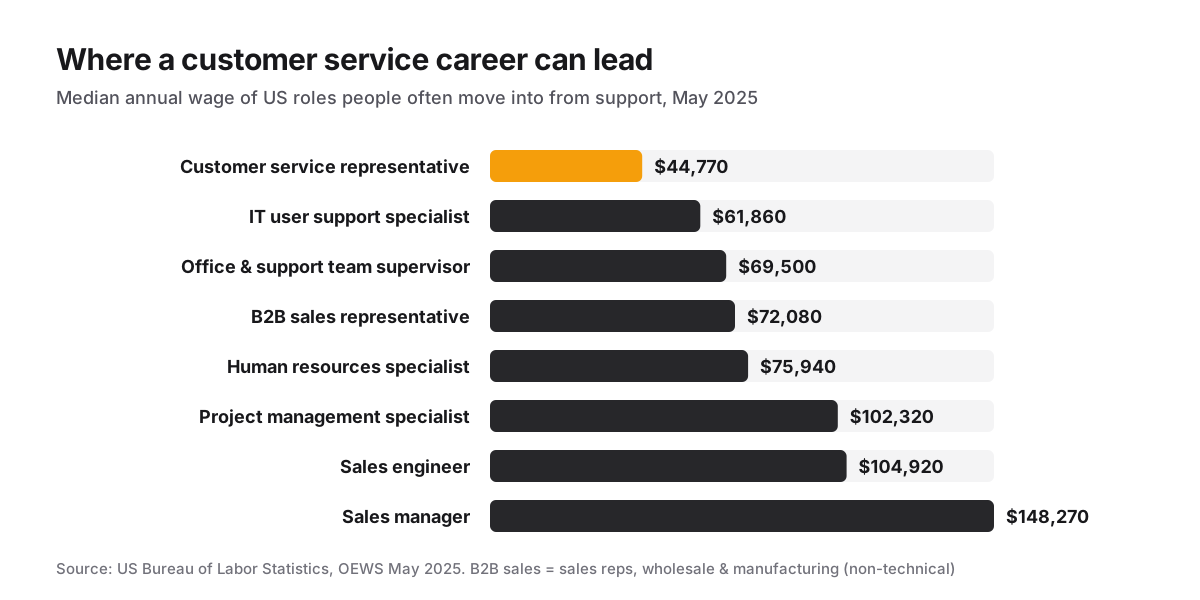
Customer service is one of the most common ways into remote work, and its median pay is modest: $44,770 in the US. But the skills it builds, like clear writing, calm problem-solving, product knowledge and CRM tools, carry straight into better-paid careers.
| Next step | Median annual wage (US) | What carries over |
|---|---|---|
| IT user support specialist | $61,860 | Troubleshooting, patience, ticket tools |
| Support team supervisor | $69,500 | Knowing the queue, coaching agents |
| B2B sales representative | $72,080 | Handling objections, product knowledge |
| Human resources specialist | $75,940 | People skills, clear writing |
| Project management specialist | $102,320 | Organising work, keeping people informed |
| Sales engineer | $104,920 | Explaining technical products |
| Sales manager | $148,270 | Leading a team that brings in revenue |
Source: BLS OEWS, May 2025. B2B sales representative is the BLS group "sales representatives, wholesale and manufacturing, except technical and scientific products".
Sales development (SDR) and account management are the most natural next steps from support. They use the same skills and they are among the fastest-growing remote fields this year.
How to choose a well-paid career
- 1.Start from the family, not the title. Pick a field that pays well and that you can see yourself growing in, like tech, finance, sales or healthcare.
- 2.Check the growth. A field with many new openings gives you more chances to get in and move up.
- 3.Count the cost of getting in. Medicine pays the most but takes a decade. Tech support, sales and project management can be entered in months with the right skills and proof.
- 4.Plan the second and third job. The biggest pay jumps come from moving up a level, into a specialist or leadership role.
- 5.Think about where your employer is. If you can work remotely, the market that pays you matters as much as the career. Our hourly-to-monthly salary guide shows what US-dollar pay is worth in your currency.